Have We Found Guinsville?
In working on the Guinsworld website we are constantly confronted with the question of how to spell Gins/Guins and that leads to the deeper question of where the name came from. Is it shortened from Ginsberg in accordance our Jewish roots? More far-fetched speculation has the name as shortened version of Guiness. After all, the novelist/poet Lermontov’s surname is actually a Russified version of the Scottish Learmonth. As the following blog attempts to show the most likely provenance goes back to a small town in what is now western Hungary.
Origin of Gins Surname Including Edited Excerpts from 2009 Correspondence
Boris Dralyuk, a multilingual Ph.D. with a specialty in Eastern European languages and I (Susan Morris) have been working to extend the Gins/Guins family back beyond our deepest known Gins ancestor, Manasse Lippmann Gins, who was born around 1746 in Poland. While we don't have any confirmed new family members to announce yet, we have background information on the Gins family name as well as details about other Gins living in Eastern Europe at the same time as our relatives.
Most individuals in Europe (other than nobles) did not have surnames until late Middle Ages. In Poland, the nobles adopted names of their estates beginning in the 15th century, but the townsfolk, peasants and Jews did not routinely use surnames until the 18th and 19th centuries.
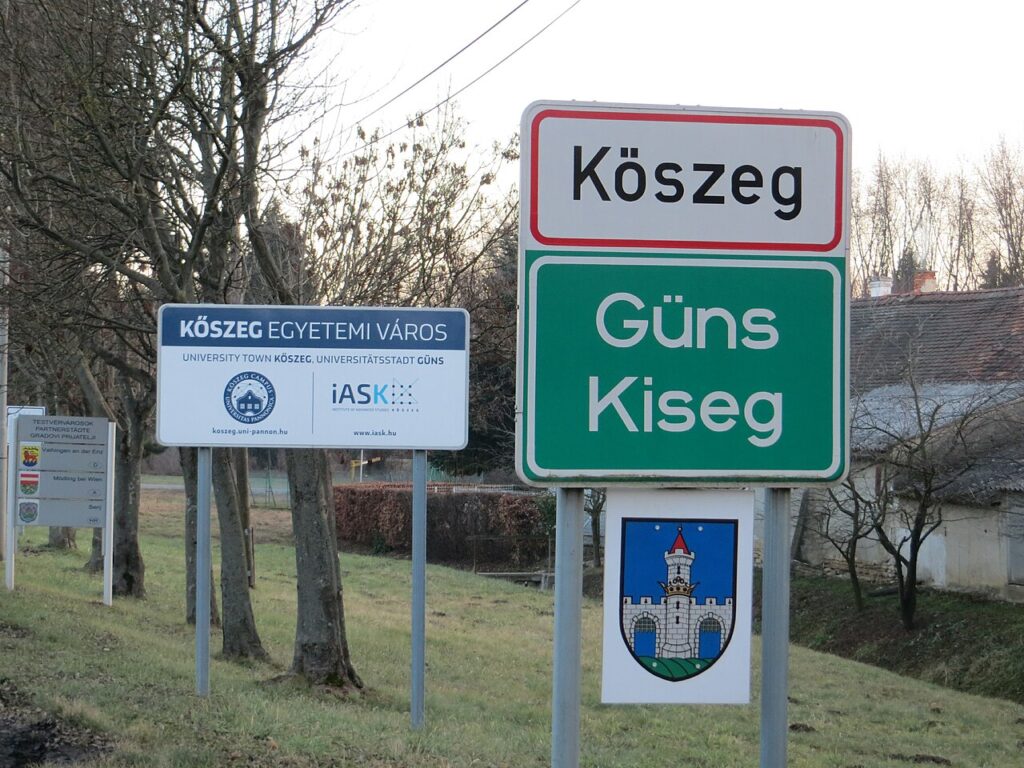
There are different ways that the people who became our Gins relatives could have acquired the surname Gins (patronymic/matronymic, profession, characteristic, location, nickname). It seems likely that the name Gins came from a specific location. According to Dan Rottenberg's Finding Our Fathers, a Guidebook to Jewish Genealogy (1986),"Among Ashkenazi Jews, a family often adopted the name of its hometown as a surname after it had moved elsewhere." The closest locality to Kalisz, Poznan, Poland (where Morits Emil Gins was born) with the name Gins was a town in western Hungary called Köszeg, also known as Gins in German (spelled Güns), when the area was part of the Austro-Hungarian empire. Köszeg/Güns was occupied by people who later adopted the surname Gins after moving to Germany and Poland. Köszeg/Güns lies west of Budapest.
Boris' news about Gins in Central Europe from 2009 correspondence:I have a strong hunch that the Maurycy Emil [Polish spelling of Morits Emil Gins] branch of the Gins family may be at least tangentially related to the famed Rabbi Akiva [Akiba] Eger [Eiger] ben Moses Gins [Guens / Güns] (1761-1837):
The Jewish Encyclopedia (1901-1906) describes the Eger clan as follows: "A family established for a long time at Halberstadt, Germany. It appears to have been originally known by the name of "Gins" or "Ginsmann," by which appellation the first two definitely authenticated members, Mayer and David, are known. R. Akiba Eger of Posen, likewise called himself "Ginsmann" while in Friedland. To the same family probably belongs Jacob Egers, sometime teacher at the Training-School for Teachers in Berlin."
The same source indicates that Akiva's son, Solomon (1785-1852), was a prominent spiritual leader in Kalisz -- the home, according to Neofici polscy, of Maurycy Emil’s [Morits Emil's] parents, Lewi (Ludwik) Gins and Ryfka (Frydryka) Holtz:
"In 1830 [Solomon] became rabbi of Kalisch, Russian Poland, and on the death of his father (1837) he succeeded him in the rabbinate of Posen, which charge he held till the year of his death." Other sources, like the Universal Jewish Encyclopedia (Ed. Isaac Landman, Louis Rittenberg, etc., 1948), corroborate this information.
There's an undeniable similarity between the Gins sounding surname in Wales and the Gins in Central Europe, but it really does appear that the Ginses we're dealing with are of Continental European origin. These Continental Ginses might very well have had a presence in Scotland, though.
My feeling is that Maurycy Emil [Morits Emil] (and especially his children) might have used the presence of relatives in Scotland and the similarity between the sound of their Austrian-Polish-Jewish surname to the Celtic "Gwyne" in order to "pass". I've read many Russian bios of George Constantine in the past weeks, and most of them begin by stating that his paternal grandfather was a Russified Englishman ["obrusevshij anglichanin"]. Knowing what we know of Maurycy Emil's history, it's hard not see this as obfuscation necessitated by unbearable anti-Semitic pressure in late-Imperial Russia.
(End of Boris' comments).
Clue from Given Name
From Finding Your Polish Ancestors by Kathleen Ann La Budie-Szakall & Jan Steven Zaleski, I learned that in the Prussian partition (Kalisz, Poznan, Poland was in this partition until it became part of the Russian Empire) depending on the German influence, children might have two given names: the first in honor of a relative, and the second for use in the immediate family. There is then the possibility that the name Morits was in honor of a grandparent or other important relative. Moses Gins, the father of Akiva Gins Eger, was also known as Moritz Moshe Gins (Moshe is the Hebrew form of Moses). This Moses/Moshe Moritz Gins was old enough to be the brother of Lipman Ludwig Gins’ father, Manasse. If he is a granduncle to our Morits Emil Gins -- and we do not have documentary confirmation of this, yet -- then we could trace the Gins family line all the way back to Moses Gins’ father, Samuel Gins, or earlier generations.
Additional genealogical information comes from my great-aunt, Evgenija Vladimirovna Gins, born in 1901 in Chisinau, Moldova, part of Bessarabia in the Russian Empire. She claimed to have been born in Budapest, Hungary according to a 1957 brochure published by the Sherman Art Gallery, Chicago, to promote an exhibit of Evgenija’s artwork. Evgenija may have invented an exotic-sounding birth location to embellish her resume, but perhaps she knew more about Gins family history than she disclosed. It may have been a well-guarded family secret or family lore that our Gins ancestors originally came from the established Jewish community in the city of Köszeg/Güns (Gins), west of Budapest. In another possible nod to our Central European heritage, Evgenija altered her birth name in the gallery brochure and used the surname “deGins”. The “de” in front of a surname means “of” or “from” in many Latin-based languages. So, Evgenija was literally stating that her family was from the location known as Gins. She could have added the “de” to hint at noble or aristocratic status, which is another use of the prefix. Whatever her reasons, these two details – a purported birth in Budapest, Hungary, and the use of deGins indicating “of” or “from” – are tantalizing clues that Evgenija may have been aware of the Gins family’s Austro-Hungarian origins.
New Information-- DNA Cousins and the Gins surname in Central Europe
When we first started researching our Gins/Guins ancestors in 2009, Boris Dralyuk made the argument that our Gins family was likely connected to that of well-known Rabbi Akiva Gins Eger but we couldn’t document the relationship with paper records. I can now report that I have two new DNA cousins (two from AncestryDNA, and one of the two also on MyHeritage DNA) who share enough cMs (centimorgans, a measurement of DNA) with me to indicate a Most Recent Common Gins ancestor at the 4th-7th great-grandparent range.
These two cousins, whose surnames are Eiger (male) and Furst (female), are descended from Solomon (Shlomo) Eger (also spelled and pronounced Eiger), 1785-1853, who was a Rabbi in Kalisz, Poland where Morits Emil was born. Solomon Eger was the son of Rabbi Akiva Gins Eger, 1761-1837, and grandson of Moses Gins, who died in Eisenstadt, Austria, 1780. Born in Eisenstadt with the name Akiva Gins, Rabbi Akiva Gins Eger took the surname Eger to please his mother, Gitl. He was referred to as Akiva Eger the younger since his maternal grandfather had the same name. The Gins-Eger family tree from Jacob H. Sinason’s, The Gaon of Posen, illustrates these relationships and is included with this blog (Sinason 1991:112).
Rabbi Akiva Gins Eger’s son Solomon isn’t the only one of interest in our genealogical research: Akiva’s eldest son, Avraham, also has a connection to the town of Rawicz, Poland, originally in Prussia, where Lipman Gins was born to Manasse and his wife, Ryfka. Avraham Eger met his wife Chaya in the home of a host in Rawicz and later Avraham served there as Rabbi.
However, given the amount of shared DNA with the Eiger and Furst cousins, 13 cMs and 8 cMs respectively (weighted, per AncestryDNA), it is much more likely that our common Gins ancestor is deeper, probably at the level of Akiva Gins Eger’s grandfather Samuel Gins or more distant. There is also the possibility that we are related to Akiva Gins Eger’s mother Gitl’s ancestral line. Her father was Rabbi Akiva Eger the elder who was born in Bratislava/Pressburg, Royal Hungary, now Slovakia, about 1722 and died in 1758. Akiva Eger the elder’s distant ancestor was Maier Ginsmann of Halberstadt, who died in 1672.
For comparison, I share the following amounts of DNA with Gins relatives who uploaded their results to AncestryDNA: Genevieve Bancroft, 36 cMs; Thomas Guins, 33 cMs; and Vicky Mlyniec, 29 cMs (weighted, per AncestryDNA). The DNA that we share indicates we are at the 3rd cousin level, with Morits Emil Gins as our Most Recent Common Ancestor (Morits Emil is my 2nd great grandfather). This is why the lesser amounts of DNA that I share with the Eiger and Furst matches indicates a connection through a more distant common ancestor.
So, from these two new DNA cousins matches whose ancestors include the Gins-Eger clans, we’ve learned that we are highly likely to be connected to a Gins family tree that stretches back through Poland and Prussia/Germany, to Austria, Czechia, Slovakia, and Hungary. I’m continuing to look for documentary and additional DNA evidence for Manasse Gins’ father to help us identify specific ancestors. At the very least, I think we can claim that we have Gins relatives dating between the 16th and 18th centuries in Central Europe.
By Susan Morris
