In working on the Guinsworld website we are constantly confronted with the question of how to spell Gins/Guins and that leads to the deeper question of where the name came from. Is it shortened from Ginsberg in accordance our Jewish roots? More far-fetched speculation has the name as shortened version of Guiness. After all, the novelist/poet Lermontov’s surname is actually a Russified version of the Scottish Learmonth. As the following blog attempts to show the most likely provenance goes back to a small town in what is now western Hungary.
Origin of Gins Surname Including Edited Excerpts from 2009 Correspondence
Boris Dralyuk, a multilingual Ph.D. with a specialty in Eastern European languages and I (Susan Morris) have been working to extend the Gins/Guins family back beyond our deepest known Gins ancestor, Manasse Lippmann Gins, who was born around 1746 in Poland. While we don't have any confirmed new family members to announce yet, we have background information on the Gins family name as well as details about other Gins living in Eastern Europe at the same time as our relatives.
Most individuals in Europe (other than nobles) did not have surnames until late Middle Ages. In Poland, the nobles adopted names of their estates beginning in the 15th century, but the townsfolk, peasants and Jews did not routinely use surnames until the 18th and 19th centuries.
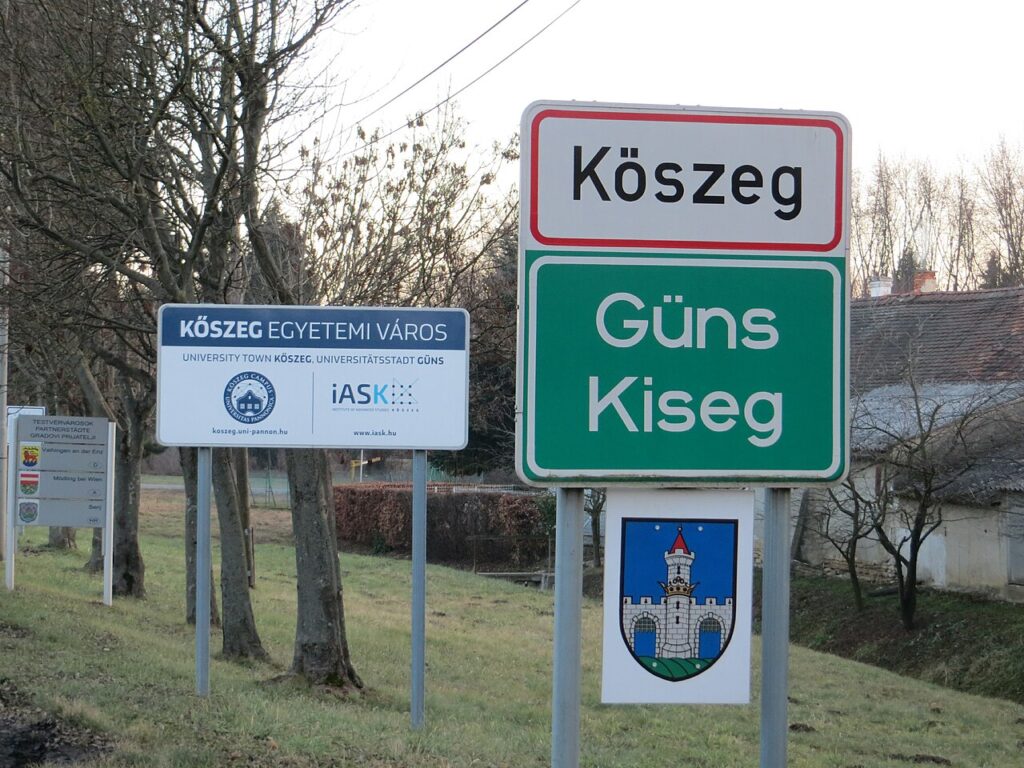
There are different ways that the people who became our Gins relatives could have acquired the surname Gins (patronymic/matronymic, profession, characteristic, location, nickname). It seems likely that the name Gins came from a specific location. According to Dan Rottenberg's Finding Our Fathers, a Guidebook to Jewish Genealogy (1986),"Among Ashkenazi Jews, a family often adopted the name of its hometown as a surname after it had moved elsewhere." The closest locality to Kalisz, Poznan, Poland (where Morits Emil Gins was born) with the name Gins was a town in western Hungary called Köszeg, also known as Gins in German (spelled Güns), when the area was part of the Austro-Hungarian empire. Köszeg/Güns was occupied by people who later adopted the surname Gins after moving to Germany and Poland. Köszeg/Güns lies west of Budapest.
Boris' news about Gins in Central Europe from 2009 correspondence:I have a strong hunch that the Maurycy Emil [Polish spelling of Morits Emil Gins] branch of the Gins family may be at least tangentially related to the famed Rabbi Akiva [Akiba] Eger [Eiger] ben Moses Gins [Guens / Güns] (1761-1837):
The Jewish Encyclopedia (1901-1906) describes the Eger clan as follows: "A family established for a long time at Halberstadt, Germany. It appears to have been originally known by the name of "Gins" or "Ginsmann," by which appellation the first two definitely authenticated members, Mayer and David, are known. R. Akiba Eger of Posen, likewise called himself "Ginsmann" while in Friedland. To the same family probably belongs Jacob Egers, sometime teacher at the Training-School for Teachers in Berlin."
The same source indicates that Akiva's son, Solomon (1785-1852), was a prominent spiritual leader in Kalisz -- the home, according to Neofici polscy, of Maurycy Emil’s [Morits Emil's] parents, Lewi (Ludwik) Gins and Ryfka (Frydryka) Holtz:
"In 1830 [Solomon] became rabbi of Kalisch, Russian Poland, and on the death of his father (1837) he succeeded him in the rabbinate of Posen, which charge he held till the year of his death." Other sources, like the Universal Jewish Encyclopedia (Ed. Isaac Landman, Louis Rittenberg, etc., 1948), corroborate this information.
There's an undeniable similarity between the Gins sounding surname in Wales and the Gins in Central Europe, but it really does appear that the Ginses we're dealing with are of Continental European origin. These Continental Ginses might very well have had a presence in Scotland, though.
My feeling is that Maurycy Emil [Morits Emil] (and especially his children) might have used the presence of relatives in Scotland and the similarity between the sound of their Austrian-Polish-Jewish surname to the Celtic "Gwyne" in order to "pass". I've read many Russian bios of George Constantine in the past weeks, and most of them begin by stating that his paternal grandfather was a Russified Englishman ["obrusevshij anglichanin"]. Knowing what we know of Maurycy Emil's history, it's hard not see this as obfuscation necessitated by unbearable anti-Semitic pressure in late-Imperial Russia.
(End of Boris' comments).
Clue from Given Name
From Finding Your Polish Ancestors by Kathleen Ann La Budie-Szakall & Jan Steven Zaleski, I learned that in the Prussian partition (Kalisz, Poznan, Poland was in this partition until it became part of the Russian Empire) depending on the German influence, children might have two given names: the first in honor of a relative, and the second for use in the immediate family. There is then the possibility that the name Morits was in honor of a grandparent or other important relative. Moses Gins, the father of Akiva Gins Eger, was also known as Moritz Moshe Gins (Moshe is the Hebrew form of Moses). This Moses/Moshe Moritz Gins was old enough to be the brother of Lipman Ludwig Gins’ father, Manasse. If he is a granduncle to our Morits Emil Gins -- and we do not have documentary confirmation of this, yet -- then we could trace the Gins family line all the way back to Moses Gins’ father, Samuel Gins, or earlier generations.
Additional genealogical information comes from my great-aunt, Evgenija Vladimirovna Gins, born in 1901 in Chisinau, Moldova, part of Bessarabia in the Russian Empire. She claimed to have been born in Budapest, Hungary according to a 1957 brochure published by the Sherman Art Gallery, Chicago, to promote an exhibit of Evgenija’s artwork. Evgenija may have invented an exotic-sounding birth location to embellish her resume, but perhaps she knew more about Gins family history than she disclosed. It may have been a well-guarded family secret or family lore that our Gins ancestors originally came from the established Jewish community in the city of Köszeg/Güns (Gins), west of Budapest. In another possible nod to our Central European heritage, Evgenija altered her birth name in the gallery brochure and used the surname “deGins”. The “de” in front of a surname means “of” or “from” in many Latin-based languages. So, Evgenija was literally stating that her family was from the location known as Gins. She could have added the “de” to hint at noble or aristocratic status, which is another use of the prefix. Whatever her reasons, these two details – a purported birth in Budapest, Hungary, and the use of deGins indicating “of” or “from” – are tantalizing clues that Evgenija may have been aware of the Gins family’s Austro-Hungarian origins.
New Information-- DNA Cousins and the Gins surname in Central Europe
When we first started researching our Gins/Guins ancestors in 2009, Boris Dralyuk made the argument that our Gins family was likely connected to that of well-known Rabbi Akiva Gins Eger but we couldn’t document the relationship with paper records. I can now report that I have two new DNA cousins (two from AncestryDNA, and one of the two also on MyHeritage DNA) who share enough cMs (centimorgans, a measurement of DNA) with me to indicate a Most Recent Common Gins ancestor at the 4th-7th great-grandparent range.
These two cousins, whose surnames are Eiger (male) and Furst (female), are descended from Solomon (Shlomo) Eger (also spelled and pronounced Eiger), 1785-1853, who was a Rabbi in Kalisz, Poland where Morits Emil was born. Solomon Eger was the son of Rabbi Akiva Gins Eger, 1761-1837, and grandson of Moses Gins, who died in Eisenstadt, Austria, 1780. Born in Eisenstadt with the name Akiva Gins, Rabbi Akiva Gins Eger took the surname Eger to please his mother, Gitl. He was referred to as Akiva Eger the younger since his maternal grandfather had the same name. The Gins-Eger family tree from Jacob H. Sinason’s, The Gaon of Posen, illustrates these relationships and is included with this blog (Sinason 1991:112).
Rabbi Akiva Gins Eger’s son Solomon isn’t the only one of interest in our genealogical research: Akiva’s eldest son, Avraham, also has a connection to the town of Rawicz, Poland, originally in Prussia, where Lipman Gins was born to Manasse and his wife, Ryfka. Avraham Eger met his wife Chaya in the home of a host in Rawicz and later Avraham served there as Rabbi.
However, given the amount of shared DNA with the Eiger and Furst cousins, 13 cMs and 8 cMs respectively (weighted, per AncestryDNA), it is much more likely that our common Gins ancestor is deeper, probably at the level of Akiva Gins Eger’s grandfather Samuel Gins or more distant. There is also the possibility that we are related to Akiva Gins Eger’s mother Gitl’s ancestral line. Her father was Rabbi Akiva Eger the elder who was born in Bratislava/Pressburg, Royal Hungary, now Slovakia, about 1722 and died in 1758. Akiva Eger the elder’s distant ancestor was Maier Ginsmann of Halberstadt, who died in 1672.
For comparison, I share the following amounts of DNA with Gins relatives who uploaded their results to AncestryDNA: Genevieve Bancroft, 36 cMs; Thomas Guins, 33 cMs; and Vicky Mlyniec, 29 cMs (weighted, per AncestryDNA). The DNA that we share indicates we are at the 3rd cousin level, with Morits Emil Gins as our Most Recent Common Ancestor (Morits Emil is my 2nd great grandfather). This is why the lesser amounts of DNA that I share with the Eiger and Furst matches indicates a connection through a more distant common ancestor.
So, from these two new DNA cousins matches whose ancestors include the Gins-Eger clans, we’ve learned that we are highly likely to be connected to a Gins family tree that stretches back through Poland and Prussia/Germany, to Austria, Czechia, Slovakia, and Hungary. I’m continuing to look for documentary and additional DNA evidence for Manasse Gins’ father to help us identify specific ancestors. At the very least, I think we can claim that we have Gins relatives dating between the 16th and 18th centuries in Central Europe.
By Susan Morris

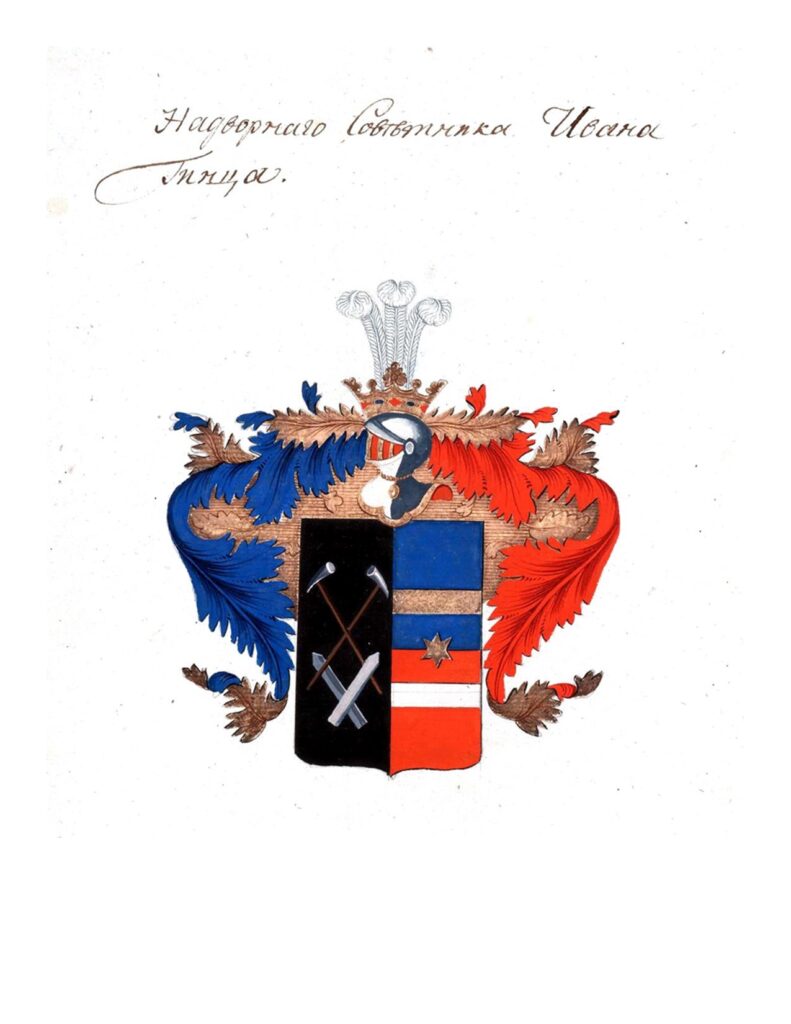
With indefatigable research our Moscow-based Guins relative, Eduard Gins, has delved into the origins of the Guins/Gins name and discovered a few distant relations in the process. He also found the above Coat of Arms of the Kingdom of Poland presented to Ivan Gints, Court Councilor as a newly certified member of the nobility. (Description below)
Eduard Gins's report follows:
For a long time, I have searched and studied many different materials and documents that relate or may relate to the history of our family and our surname. In different materials there are different spellings of our surname, as well as patronymics. You yourself saw different spellings, for example: Emelyanovich instead of Emilevich, or in general Andreevich, Emilevich instead of Moritz-Emilevich! According to the rules of the Russian language, which were in the 18th-20th centuries. Our surname could be written like this: Gins, Gints, Ginze, Hins, Hints (Гинc, Гинц, Гинцъ, Гинце, Гинца, Хинс, Хинц, Хинце, Хинца), and other spellings of the surname. I also reviewed documents about the Polish spelling of the surname Gins, in most cases it starts with X or H, and with G. And as it turned out, there were also representatives who had the same surname. They lived and served in St. Petersburg, Moscow and Russian Poland! If we believe that our ancestors were Jews, then of course in Tsarist Russia, they could not serve in many occupations. And as I have seen they all changed their religion. Until today, I haven't been able to connect them to our last name! But, I still think and assume that there is some sort of relationship, possibly very distant connection between these people and our family! I proceed from the point of view that in those years, families were large, there were at least four children. So our great-great-great-grandfather Ludwig must have had brothers and sisters, about which we now know nothing at all! And so their children or relatives could also come to Russia in St. Petersburg and serve here. Examples:
1. In 1775 in St. Petersburg, a carriage was commissioned by the St. Petersburg Orphan's Institute from the carriage master Gins, for which he was paid 140 rubles. In those days, that was a lot of money!
2. In the period of 1775-1779, there is a record of Samuil Samuilovich Gins, a lieutenant commander, who was awarded the St. George the Victorious medal, for accomplishments in battle! This is the most revered and most respected order of Russia. The order has 4 degrees. It makes no difference that the tablets were brought into St. George's Hall in the Kremlin in Moscow!
3. Schema-nun Junia (Irina Grigoryevna Gintz/Hintz), Eastern Rite Catholic was born on October 22, 1907 in St. Petersburg. She emigrated to Italy with her family at an early age and was an icon painter. She labored in the Russian Catholic Assumption Monastery of the Eastern Rite, founded in the late 1940s. She died July 25, 1998 in Rome. She was buried at the Testaccio cemetery in Rome (in the common grave of the Russian Catholic Assumption Monastery of the Eastern Rite). Compiled according to sources: Non-Catholic cemetery for foreigners in Rome: Alphabetical list of Russian burials / Comp. V. Gasperovich, M. Yu. Katin-Yartsev, M. G. Talalay, A. A. Shumkov (Russian necropolis. Vol. 6). St. Petersburg: VIRD, 1999. S. 124.
4. Modest Mikhailovich Gints: The full service record of Ensign Modest Mikhailovich Gints, who is in the 3rd Naval crew of the Corps of Mechanical Engineers, compiled January 1, 1864. The position corrects according to its rank. Born 1840, the son of a Collegiate Assessor. A native of the city of St. Petersburg. Lutheran, educated at the Engineering and Artillery School of the Naval Department, Conductor of the Corps of Mechanical Engineers in 1861. Ensign since 1863.
5. Consideration of the issue of approving the Coat of Arms of GINTS (Ivan Gints, Court Councilor)! Coat of Arms of the Kingdom of Poland Presented to Newly Certified Nobility. Comments and additional information: The form of the diploma for the nobility of the Court Councilor Ivan Gints states: “The Court Councilor Ivan Gints entered the service in 1772 at the St. Tauride Province to the Feodosia Mint as Mints-meister; May 1790, 9th Captain; December 31, 1794 at the St. Petersburg Mint, Collegiate Assessor; May 30, 1796, manager at the Kherson Mint; February 18, 1796, to the State Loan Bank Senior Accountant; the same year, October 30, Court Counselor; January 31, 1800, dismissed from his post due to illness.” The petition of the Court Councilor Ivan Gints for the issuance of a diploma and a coat of arms for his nobility was heard by Heraldry on January 19, 1816. By decree of His Imperial Majesty, the Governing Senate on March 24, 1816: They listened: the petition of the Court Councilor Ivan Gints for the issuance of a diploma and coat of arms to him for noble dignity. They ordered: since the petitioner Court Councilor Ivan Gints in his service and rank ... is in noble dignity, then the form and coat of arms composed for him in the Heraldry, rewritten with an ordinary decoration, to be raised to His Highest Imperial Majesty for signing. The Journal of Heraldry on July 5, 1843, which took place, among other things, concluded: the case of issuing a diploma to the noble dignity to the Court Councilor Ivan Gints should be considered finished and, together with the diploma made in sheets, handed over for storage to the Heraldry archive. In the case of Gintz appearance, announce that he should wish to receive a diploma, renew his request and submit the money needed for this again. The diploma was made in sheets and kept in the Heraldry. RGIA, f.1343, op.19, file 1760, l.6 (fig.), ll.7 and ob.
by Eduard Guins
It’s not often that we find items belonging to our distant ancestors; in fact, it’s very rare. But Eduard Gins, who lives in a
suburb of Moscow, managed to do just that recently, by an amazing coincidence! Actually, Eduard made his own luck by
searching through an antiques market in June. Eduard shared his extraordinary discovery with Sara Guins, Vicky
Mlyniec, and me a few days later. Below, Eduard, who has already published four books on his Russian family history,
describes how he found and purchased a rare object that was once a treasured Gins family heirloom. (Translation from
Russian via Google Translate).


Eduard Gins found the above graduation medallion that had been issued to Konstantin Emilevich Gins following completion of courses at the St. Petersburg Topographic Institute in 1881. Konstantin Gins’ name is engraved on the front (photo, left) of the medallion. The reverse side (photo, right) includes dates connected with the history of the Topographic Institute. Photographs courtesy of Eduard Gins.
Stories From My Life by Eduard Guins
Life is very interesting and very often unknowable! I have previously told stories of how and why I began to study the history of our extended (Guins) family. I am very lucky in this life! I met a lot of good, smart and sympathetic people who helped me collect and restore family history. I'm still trying for twenty years to collect items, badges, medals, orders dedicated to our ancestors and others that describe the whole life of a person who was born in Tsarist Russia, studied, served, married, his family, children, property, his exploits and awards and titles and ranks.
So, I visit various antique shops, exhibitions, fairs and other events where they sell or present items related to the period of Tsarist Russia. On Saturday, the first of July, I visited the corridors of the Izmailovo antiques market (near Moscow) to look for tokens and medals about the graduation from educational and military institutions of Tsarist Russia. Arriving at the market, I walked along the rows and at first I was not interested in much, then I saw the badge of a sailor dated 1902. The seller turned out to be a young man named Marat. We talked, I bargained with him and in order not to offend him I made him a payment with a minimum discount. Marat thanked me and gave me a coin of three kopecks as a sign of good luck to my grandson or son. To which I answered him, there are no grandchildren yet! He said - all the same, good luck to you and your son! At another stall I saw the token of the captain of the tsarist army, we bargained a little, I talked with the owner of the store about the price of other awards, and for some reason I decided not to buy this medal, but instead to go for a walk! This is where you need to understand and remember! For exactly one hour I walked completely senselessly along the corridors of the Izmailovo antiques market! These are hundreds of sellers and antique stalls!!! I looked at the shelves a little distracted! And suddenly! Who knows what spurred me on this trip and to stop at a particular counter. I found out the owner's name was Konstantin!!! So, I stopped at the counter, where more than eighty percent of the goods were jewelry! And only two sections were devoted to awards and medals. There I saw two medals that I absolutely did not need! Konstantin said that he had a large collection of other tokens, which he had been collecting for forty years since 1969! He took out a small stockbook, in which lay open a medal about the end of the Mikhailovsky Artillery School. I asked about its price, I remember the prices at auctions and sales and it seemed very reasonable. And in another compartment, in two packages, there was another medal. I asked what it is and can I see it? Konstantin gave me a medal one side with epaulettes and said, this is a medal of the end of training at the military topographic school!

School of Topographers, St. Petersburg. Photograph courtesy of Eduard Gins.
At that moment, I didn’t even remember which of my ancestors might have studied there! I took the phone and turned on the electronic magnifier to get a better view of the medal. When I turned it over and saw what was written there! My hands trembled and goosebumps went all over my body! I was numb!!! I asked the price of this item. When the seller, Konstantin, quoted me, I said it was the medal of (Constantine Emilievich Guins) my cousin’s great grandfather, the brother of my great-grandfather Modest Emilievich Guins! Of course he didn't believe me! The seller and several nearby sellers thought that I was a dealer who was buying things. I showed my documents and some photographs from the archive. I asked Konstantin not to sell for a couple of days, that I will think it over and call. We exchanged phone numbers. I left with my mind in a whirl, but even then, I decided to buy this medal. But first I wanted to check the archival documents about Constantine Emilevich Guins. Secondly, I called my friendly antique dealers who sell old Russian orders, medals, tokens from the time of the tsarist Empire. I wanted to know the medal’s fair price. I also wanted to talk to my family. When I checked everything and made sure that this was indeed our ancestor, I decided one hundred percent - I'm buying.
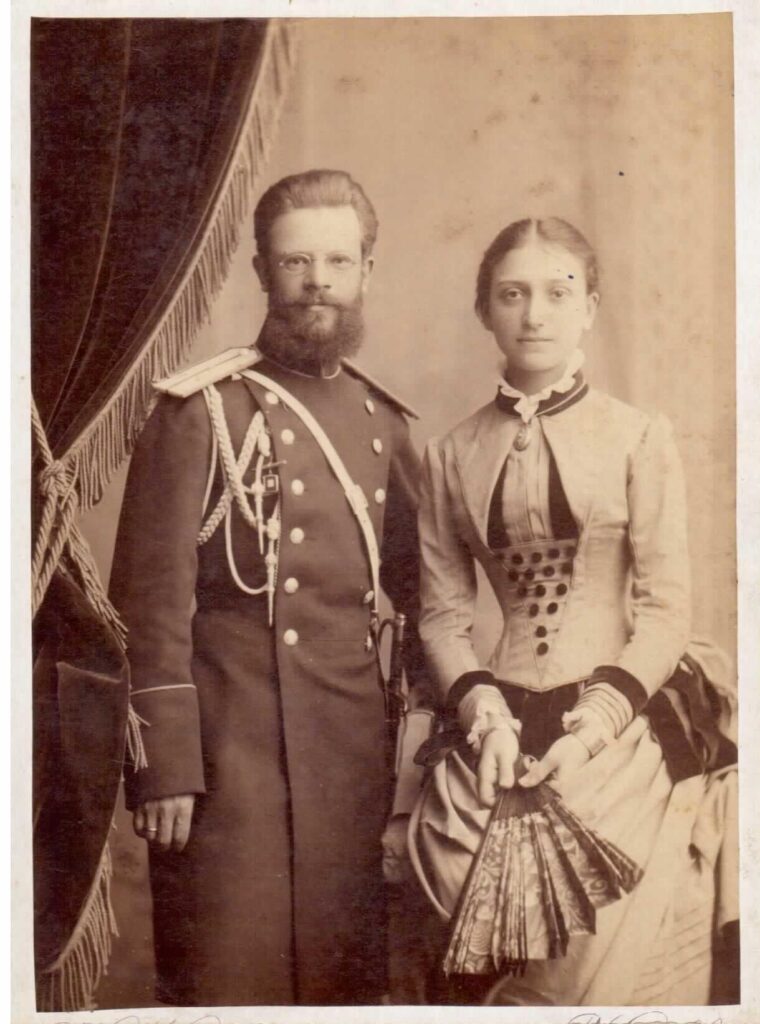
Constantine Emilievich Guins and his wife Ekaterina Lamzaki Guins
I am completely sure now that our Lord and our ancestors led me to this seller so that I could close one of the circles of family history and return the medal that belonged to our ancestors to the family! The next day, I went and bought this medal. The seller Konstantin and his acquaintances, until the last moment, did not believe that this was possible! Neither did I. To find the graves of your ancestors when you know a little bit about where they are buried. It's possible. Long, difficult, but possible! But, to find something like this - a thing that belonged to your ancestor, he wore it, held it in his hands! This is something supernatural!!
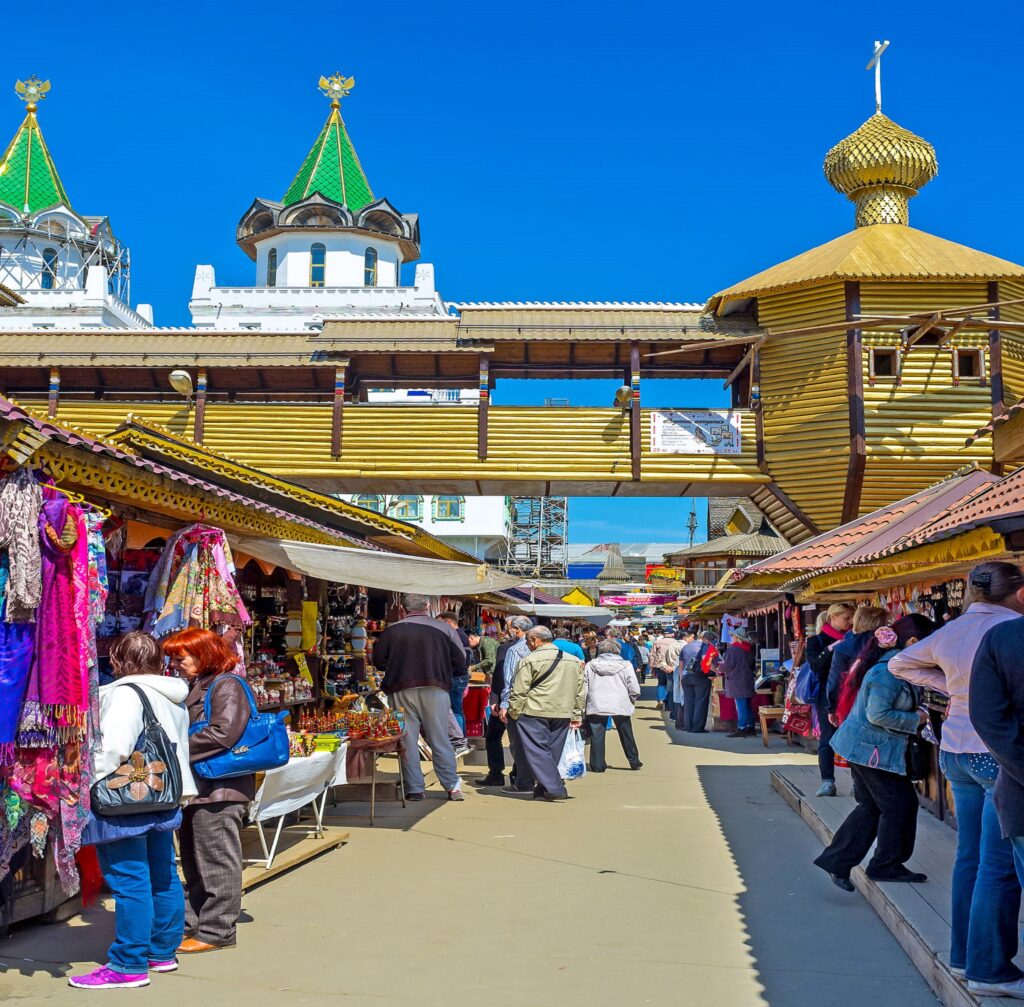

Ismailovski Market in Moscow Suburbs
Guins siblings all became Christians in 19th century Poland.
The above is a 22 January 1856 marriage certificate for (Morits) Emil Gins, 27 years old, and Maria Konstantinovna Golubeva, 19 years old, at the St. Vladimir Cathedral, St. Petersburg, Russia. Morits Emil Gins’ older brother, Julius, appeared as a witness at the wedding. These Gins family history revelations came to us in 2020 as unanticipated ‘gifts’ from two genealogical researchers in Poland: Maria Kosicki and Aneta Balcerkiewicz. Both women offered to share original documents and details about our Polish-Russian Gins relatives when I joined the Israel-based MyHeritage genealogy site. I decided to ‘fish in a new pond’ since MyHeritage has records and features that aren’t available on other genealogy websites. Although Maria and Aneta aren’t closely connected to our Gins family, Maria’s husband is related through a relative who married a descendant of Alexander Gins, and Aneta is related through Emanuel Gins’ wife’s family. Both women generously shared Polish baptism, marriage, and death records along with obituaries, grave photographs, and directory listings for our Gins family. Maria and Aneta sent me files of the original documents so that I could read the Polish records after running the text through Google Translate.
From the new research, we now know much more about Morits Emil Gins brothers and sisters’ baptism status. All seven of Morits Emil’s siblings were baptized into the Christian faith during the mid-nineteenth century, including two who became Catholic:
Children of Lipmann Gins and Fryderyka Gins (nee Holtz):
Alexander Gins, b. 26 Feb 1821 in Kalisz, Poland; baptized 10 Nov 1839 in Warsaw, age 18: Evangelic-Reformed (Protestant); new name: Richart
Julius Gins, b. 1 Jan 1819 in Kalisz, Poland; baptized 2 Jan 1840 in Warsaw, age 21: Catholic Church; new name: Antoni Walewski
Manas Gins, b. 12 Oct 1816 in Kalisz, Poland; baptized 31 Oct 1841 in Warsaw, age 25: Catholic Church of St. Alexander; new name: Emmanuel
Morits Gins, b. 30 Aug 1827 in Kalisz, Poland; baptized 18/30 Oct 1842 in Warsaw, age 15: Evangelic Reformed (Protestant); new name: Emil
Bernhard Gins, b. 1823 in Kalisz, Poland; baptized 29 Nov/11 Dec 1842 in Warsaw, age 19: Evangelic Reformed (Protestant); new name: Władysław
Leopold Gins, b. 23 Jun 1825 in Kalisz, Poland; baptized 12 Feb 1843 in Zduńska Wola (near Łódź), age 17: Evangelic Church; new name: Edward
Rozalia Hirsch nee Gins, b. 1 Jun 1815 in Kalisz, Poland; baptized 1864 in Warsaw, age 47: Evangelic-Reformed (Protestant); no known alternate name
Fryderyka Reimann nee Gins, b. 1 Jan 1814 in Kalisz, Poland; baptized before 1893: Evangelic-Reformed (Protestant); alternate name: Franciszka
We have copies of original baptism documents for all the Gins brothers but not for Morits Emil’s sisters, Rozalia and Fryderyka. Rozalia’s 1864 baptism was noted in Jeski-Choinski’s Neofici polsy, along with that of her 10-year-old son, Adolf Hirsch, while Fryderyka’s baptism is assumed because she was buried next to her husband in an Evangelic-Reformed cemetery in Warsaw in 1893.
What these new documents describe is not just a change in religion from Judaism to Christianity for Morits Emil and his siblings, although that is certainly significant, with long term implications for personal safety and professional prospects. The new records show a closeknit family who stood by one another in times of celebration and sadness as witnesses to important events. We can see from Morits Emil and Maria Golubeva’s 1856 marriage record, above, that Morits Emil’s older brother, Julius, who went by the name Antoni Walewski/Anton Valevskij after baptism, was a witness at their St. Petersburg marriage. Walewski/Valevskij was listed on the marriage certificate as a Khudozhnik -- an artist or painter -- for the Imperial Academy of Sciences at that time. Antoni Walewski and his wife, Emilia, were also named as godparents for brother Alexander Gins’ daughter, Alexandra Paulina, when she was baptized in 1854 in the Evangelical-Augsburg parish, Warsaw. Antoni’s older brother, Emanuel Gins, was one of the witnesses to Antoni’s 1852 marriage to Emilia Lindner at the Catholic Church of St. Cross, Warsaw. And brothers Alexander and Leopold Gins were entered as witnesses on the 1861 death certificate for Jozef Reimann who was sister Fryderika/Francizska’s husband, as noted in records in the Evangelical-Augsburg parish, Warsaw. We don’t know if Morits Emil traveled back to Poland from Ukraine to participate in any of these family events, but he likely kept in contact through telegraphic communications, since that was his profession.
Morits Emil’s brothers and sisters are related to me as 3rd great uncles and aunts (Morits Emil Gins is my 2nd great grandfather). Your relationships will obviously vary, depending on your generation. But the descendants of the Gins siblings are also our cousins. There are likely to be dozens, if not more, Gins descendant cousins living in Poland and elsewhere. For example, Alexander and his wife Fryderyka (nee Lichtenstadt), had eight children, as did Fryderyka Gins and her husband Jozef Reimann. Leopold Gins and his wife, Marianna (nee Oppenheim), had 5 children, while Antoni Walewski and wife, Emilia (nee Lindner), had two children, that we know of. Rozalia Gins and her husband, Jacob Hirsch, had two sons, while Emanuel Gins and wife, Emilia (nee Kamienska) had one daughter. Like his older siblings, our direct ancestor, Morits Emil Gins, and his wife, Maria (nee Golubeva), had eight children. So, depending on who among our Gins relatives survived the horrors of the occupation of Poland during World War II, we could have a substantial number of cousins still living and thriving in that part of Europe. In fact, I routinely receive notices of Gins family matches among MyHeritage members who share distant DNA and paper trail connections through their ancestors. I need to follow up with these cousins and see if other researchers have Gins family photos and other family history news that is new to us.
The documents and details that Maria Kosicki and Aneta Balcerkiewicz provided have been invaluable, and it’s unlikely I would have been able to locate these records on my own. Reaching out to, and collaborating with, cousins has been a joy and a blessing. I’ll share more of what we learned about our Gins relatives’ professions and other details, including new information about our direct ancestors, Lipmann Gins and his father, Manasse, in the next blog.
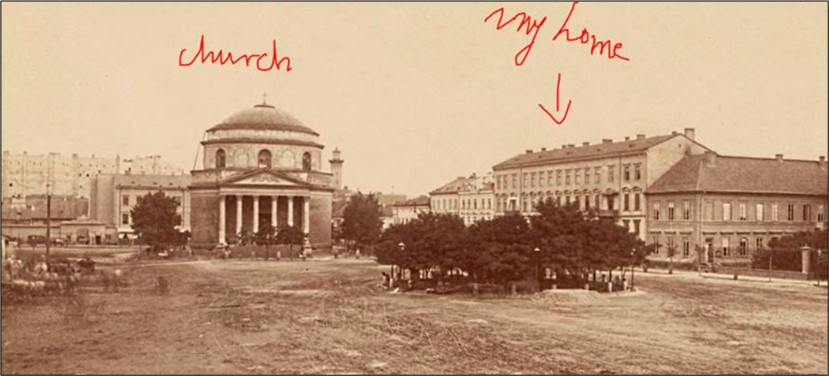
According to Aneta, Emanuel Gins lived in the building on the right in 1841, next to her ancestor’s home. Emanuel lived in the Institute of the Deaf-mutes, Instytut Głuchoniemych, on Wiejska Street in Three Crosses Square, Warsaw, where he may have worked as an office worker or teacher. He later taught at an Institute for the Education of Young Women, Aleksandryjsko Maryjski Instytut Wychowania Panien pozniejszy. Aneta believes that Emanuel would have known her family members in 1841. Photograph courtesy of Aneta Balcerkiewicz.

Contemporary photo of Three Crosses Square, Warsaw, with the Catholic Church of St. Alexander, where Emanuel Gins was baptized. Photograph courtesy of Google Maps, 2023.
References
St. Vladimir Cathedral marriages 1856, St. Petersburg Spiritual Consistory Archives, St. Petersburg, Russia, 22 Jan 1856, marriage no. 11, certificate copied out 19 May 1861, certificate no. 84, Emil [Morits Emil] Gins and Maria Konstantinovna Golubeva.
Warsaw Evangelical-Reformed Church baptisms 1839, FHL microfilm publication 689,336 (Warsaw, Poland: W.A.P. Warszawa, 26 Jul 1968), baptism no. 105, 10 Nov 1839, baptism of Alexander Richart Gins.
Warsaw Evangelical-Reformed Church baptisms 1842, FHL microfilm publication 689,336 (Warsaw, Poland: W.A.P. Warszawa, 26 Jul 1968), vol. 9, baptism/birth no. 73, 29 Nov/11 Dec 1842, baptism of Bernhard Wladyslaw Gins.
Jeske-Choiński, Teodor
1904 Neofici polscy: Materyaly Historyczne, Whitefish, MT: Kessinger Publishing, LLC.
The above list is abbreviated. Please contact us for additional references and original documents for the baptism, marriage, and burial documents mentioned above if requested.
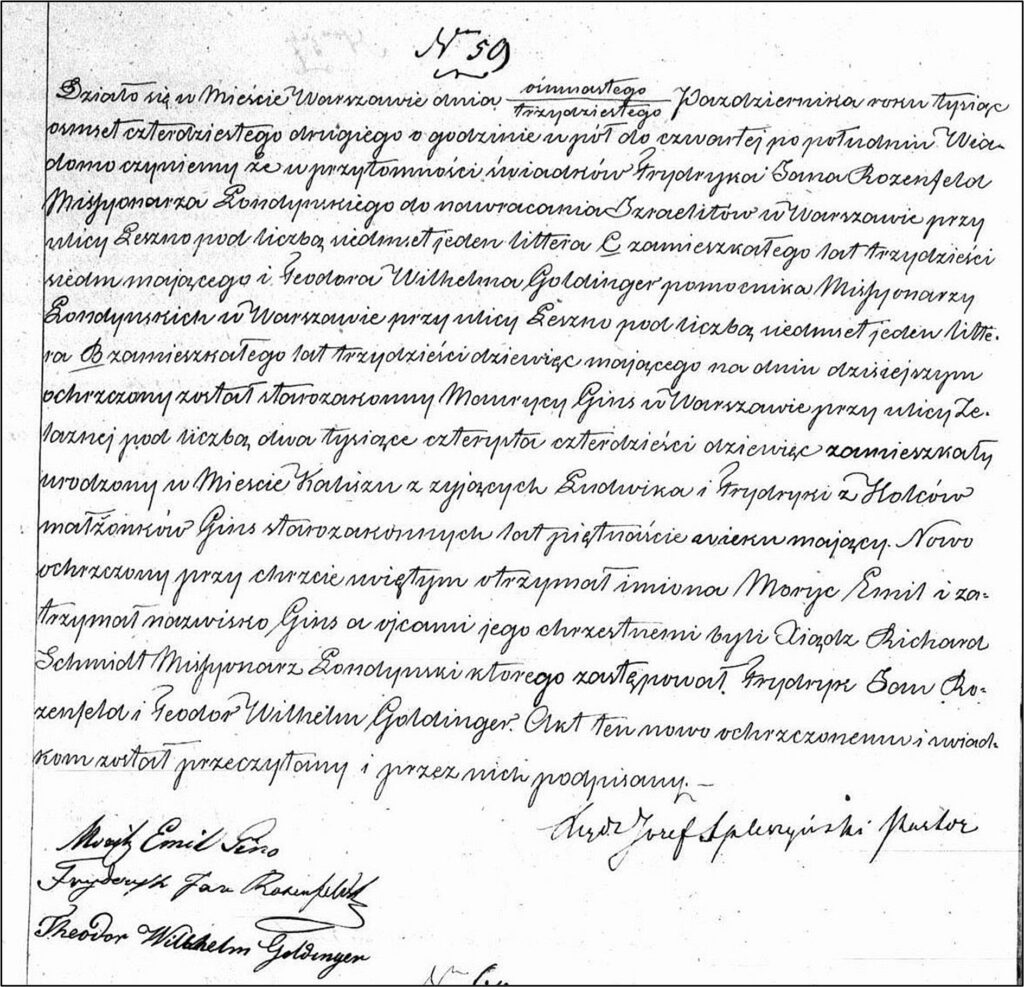
Important Ancestral Documents Discovered
We have always known that Morits Gins, our earliest common ancestor, converted to Christianity in 1842, but now we have a copy of the original baptismal record. Morits Gins, born 1827 in Kalisz, Poland, made a momentous decision that changed the course of his life when he was just 15 years old. Following in his older brother, Alexander’s, footsteps, Morits moved to Warsaw by, or before, 1842. Alexander, born in 1821, worked as a publisher and his younger brother Morits entered the printing profession as a typographer-in-training. While living in Warsaw, Alexander Gins chose to be christened in the Evangelical-Reformed (Protestant) faith on 10 Nov. 1839. Boris Dralyuk, our multilingual researcher/translator, found information about Alexander’s baptism, and that of Morits and a third brother, Bernhard, in Teodor Jeske-Choiński's (1854-1920) Neofici polscy, a volume that noted the names of people from Poland’s Jewish population who converted to Christianity along with the dates and places of their conversion.
What we hadn’t seen before were the original baptismal records for brothers Alexander, Morits, and Bernhard that included more details than those presented in Neofici polscy. In 2016, genealogist Ted Gostin located the original documents and they revealed that all three Gins brothers were baptized into the Christian faith by members of the London Society for Promoting Christianity amongst the Jews operating in Warsaw during the 19th century. Morits Gins’ sponsors for his 18 Oct. 1842 baptism were his godfather, Rev. Richard Schmidt (Smith), and witnesses Frydryk Jan Rosenfeldt and Teodor Wilhelm Goldinger. Morits was given the new name, Emil, to signify his conversion. Members of the London Society, which was founded in England in 1809, reportedly baptized 949 Jewish people in Warsaw during its tenure.
There can be no doubt that this Morits Gins who was baptized into the Christian faith in 1842 was our ancestor. His birthplace, Kalisz, and parents, Ludwik and Frydryka (nee Holz), who were still living, were listed on the Warsaw baptismal record. Morits was said to be 15 years old and this corresponds with his birth year of 1827 on the original Polish Jewish birth records in Family History Library (Mormon Church) microfilm archives. We also learned from this document that Morits Gins was living at 2449 Zelznej Street in Warsaw at the time of his conversion.
Although we do not know for certain Morits Gins’ motivation, Jews such as our Gins relatives most likely adopted the Christian faith to gain access to economic, educational, and social opportunities that were denied Jewish people in Eastern Europe during the 19th century. As an example, original documents from the archives in St. Petersburg, Russia, that summarized Morits Emil Gins’ career, demonstrate his progression through the ranks of the Russian Civil Service. He became Chief of the Kiev Central Telegraph Office, with a building directly opposite the iconic St. Sophia’s Church. This high office is something that Morits Gins would never have achieved if he had not converted from Judaism to Christianity.
We also do not know for certain why Morits Gins and his brothers chose to be baptized into the Protestant religion rather than the predominant (in Poland) Catholic faith, but according to Todd M. Endelman, in Jewish Converts in Nineteenth Century Warsaw: a Quantitative Analysis, “Jews who became Christians chose Protestantism over Catholicism because it was less offensive to them as secularists and victims of intolerance” (Endelman, 2010:286-314).
Please note that name spellings were not consistent across records and even within individual documents. Morits’ name was spelled Moryc as well as Mauryc in his Polish baptism record. And after his conversion, Morits Gins, who signed the 1842 baptismal document as Morits Emil Gins, used the name Emil Andreevich Gins while living in Ukraine. The name Emil was given to him to acknowledge his new life as a Christian, but the new patronymic or middle name was more of a puzzle. Vicky Mlyniec suggested that he used Andreevich instead of Ludvigov (a variant of his father’s name) since there was no Orthodox Russian saint by the name Ludvig. Stas Bookalo, the Ukrainian genealogist who we met in Kiev in 2010, agreed with Vicky.
In addition to baptizing our Gins family members, the London Society also owned and operated a print shop in Warsaw and sold the enterprise to Aleksander Gins in 1852. We’ll discuss the family’s involvement in the media and communications field in another blog.
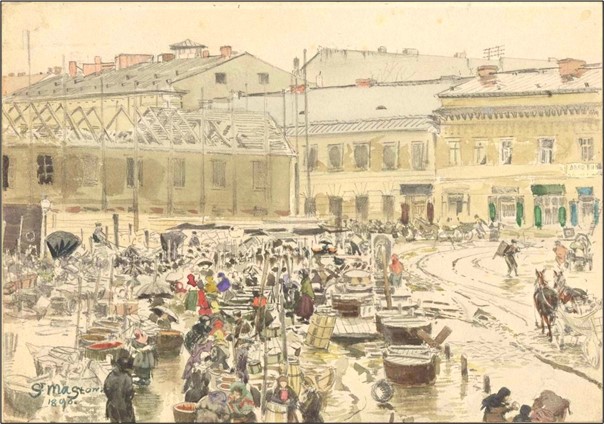
Below is a watercolor of the Iron-Gate Square marketplace in Warsaw in 1884 by Stanisław Masłowski. This is how market day in central Warsaw may have appeared to Morits Gins and his brothers while they were living in the city during the 19th century:
References
Warsaw Evangelical-Reformed Church baptisms 1842, FHL microfilm publication 689,336 (Warsaw, Poland: W.A.P. Warszawa, 26 Jul 1968), vol. 9, baptism/birth no. 59, 18/30 Oct 1842, baptism of Moryc Emil Gins.
The Matter of the Noblemen Gins, Department of Heraldry of the Governing Senate, St. Petersburg, Annotated Register of Inventories, Russian State Historical Archive, Russia: documents for the case of Morits Emil Gins who was granted hereditary nobility in August 1891 when he received the order of St. Vladimir, 4th degree. He wished to have his sons and grandsons formally “attached” to the nobility, with 77 pages of original documents.
- Doc. cover sheet with nos. 5692, 1335, 1752, Governing Senate, Department of Heraldry, The Matter of the Noblemen Gins, started: 6 Jan 1897, finished: 26 Dec 1899. Side note (next to the document): Russian State Historical Archive, Annotated Register of Inventories, Part III, Fond no. 1294-1699, St. Petersburg, 2008.
- Doc. 20568 (copy), Certificate of State Councilor Morits Emil Gins civil service record, p. 11:
"This certificate, issued by the Head of the Kiev Post and Telegraph District on August 28, 1893, No. 20568, to the Chief of the Kiev Central Telegraph Office, State Counselor Morits-Emil Ludvigov Gins, shows that he was born in 1827 to residents of the town of Warsaw, is of the Evangelical Reformed [Protestant] faith, and possesses the orders: St. Vladimir 4th degree, St. Anna 2nd and 3rd degrees, and St. Stanislav 2nd and 3rd degrees. He first entered [the civil] service as a Telegraphist in February 1858 and, continuing in this department of service, was gradually awarded ranks and orders. He retired on July 30, 1893 at the rank of State Counselor, which was awarded to him on September 10, 1891. He was never reprimanded/tried. He is married to Mariia Konstantinovna and his sons are: Konstantin (December 15, 1857), Vladimir (February 29, 1864), Modest (April 1, 1870), and Aleksandr [...]" Translation by Boris Dralyuk, 2011
Jeske-Choiński, Teodor
1904 Neofici polscy: Materyaly Historyczne, Whitefish, MT: Kessinger Publishing, LLC.
Endelman, Todd M.
2010 Jewish Converts in Nineteenth Century Warsaw: a Quantitative Analysis, Broadening Jewish History, Liverpool: Liverpool University Press.
Not entirely Russian, after all
As many of you are aware, we’ve been tracing our Guins/Gins ancestors since 2008, combing through personal files and family photos, translating original Russian, Ukrainian, and Polish documents, and locating other historical records. But it was always done with the thought that we were going to find the location in Russia where our earliest Gins relatives were born. After years of research, the truth came out—and the result wasn’t what we anticipated.
The new revelations came from the work of a highly regarded Southern California genealogist, Ted Gostin, who we contacted in 2016. We had hit a genealogical ‘brick wall’ after pushing our Gins ancestry back to Ludvig Lipman Gins (born 1771) and wife, Fryderyka Holtz (born 1790), who were the parents of Morits Gins (born 1827). Morits (later known as Morits-Emil Gins) was the youngest of eight children born to the couple. The family lived for a time in Kalisz in west central Poland. Gostin, who specializes in Polish and Eastern European genealogical research, was able to find two extraordinary documents which contained details that took these Gins relatives back two earlier generations and illuminated our family history in unexpected ways.
The first original document that Gostin discovered in the Family History Library (FHL) microfilm collection of Jewish marriage records, 1811-1813, for Kalisz, Poland gave us the birthplaces of Ludvig Lipman Gins and Fryderyka Holtz, their parents’ names, and the wives’ fathers’ names in Lipman and Fryderyka’s 23 September 1811 Polish marriage record. Lipmann Gins (name spellings varied in documents) was a 40-year- old bachelor and a merchant in 1811 from the town of Rawicz in Prussia. Located in the province of Posen, Rawicz was southwest of Kalisz, where the marriage took place. According to Gostin, “It was formerly Polish territory that was taken by Prussia in the Polish partitions of 1772-1795, in which Prussia, Russia and Austria divided up the entire Polish-Lithuanian commonwealth among themselves and wiped Poland off the map for over a century.
Lipmann’s father and mother were also listed on the record: Manasse Lipmann and Ryfka, daughter of Judel. Gostin wrote this about Ryfka’s father’s name: “Judel is a Yiddish given name, a diminutive related to the Hebrew Yehudah, or Judah; her maiden name or father’s surname is not given here.”
The bride, Fryderyka Holtz, was recorded as a 21-year-old from Wrzesnia, another town in the Prussian province of Posen. Wrzesnia was northwest of Kalisz where the couple began married life. Fryderyka’s father was cut off by the margins of the page, but is likely Bar[uch] Holtz, based on information in her children’s birth records. Baruch Holtz’ wife was Hanna, daughter of Beer (more appropriately spelled Ber, another Yiddish name, meaning bear).
This 1811 marriage record also explains why the couple chose German-sounding secular names for their children as recorded on their Kalisz, Poland birth records: Fryderyka, Rozalia, Manas, Julius, Leopold, Alexander, Bernhard, and Moritz. Lipmann Gins and Fryderyka Holtz hailed from Prussia, the premier state that created the German empire, and where German was spoken.
So with this one document, we now have two additional earlier generations of Gins relatives. We can estimate their birth years as 25 years prior to the birth of their child: Manasse Lipmann and Ryfka were born about 1746, making Ryfka’s father, Judel’s, birth about 1721. Baruch Holtz and Hanna were born about 1765, while Hanna’s father may have been born about 1740. The bottom line: This 1811 Polish marriage record extends our Gins family history back more than 300 years. We now have the birthplaces of Lipman Gins and Fryderyka Holtz, Rawicz and Wrzesnia, in what was then eastern Prussia and is now western Poland. The second document that Ted located and translated was also revelatory: The 1842 Warsaw, Poland baptismal record for Moritz Gins. I’ll discuss the exceptionally interesting findings from this original record in the next post.